Friday, October 31, 2008

Media Relations

Success with the Media


An organization having a positive relationship with the media is of utmost importance to its success. Not only is the media the channel for a company's message, but it is also a constituency that much be respected. An effective balance or, "give and take" with a media source will evoke respect and mutual understanding from both parties involved. Communication professionals from within the organization must be involved in company strategy in order to provide a transparent view from any media source that comes in contact with the company.

Media coverage of companies has certainly grown in the past generation. Whether the medium is television, radio, print or Internet, there is a constant stream of media reaction and opinion to the daily functions of the business world. This is where a communications team becomes so important. The team becomes the face of an organization, and without diligence, relationships with the media can become strained.

To maintain and foster a relationship with the various sources of media, companies need to first identify the proper outlets for their messages. Researching the "angle" of an upcoming story is important in order to craft a message for the proper audience. When the media calls on a company, the company should be willing to give the outlet the proper time and preparation as to not alienate the contact. Preparation is a key factor in the success of any media relationship. An executive should be familiar with a reporter's previous works and should by all means do a complete rehearsal of the interview before it occurs. This way, the executive will appear more confident and clear while delivering his or her messages.

Jennifer Miele did an excellent job of discussing the importance of a two-way relationship between an organization and a media representative. Her first-hand knowledge of how a relationship fostered in an afternoon can last and be mutually beneficial in the future displayed the necessity of an effective media relations initiative.

First-hand Experience

During our quarterly goals meeting last week, my department discussed an impending article in a trade magazine that will detail one of our new facilities. In the meeting we brainstormed ideas and topics for our executive to discuss with the reporter. This was the first step in what will be an intense preparation for our executive. He will be briefed on all important statistics and how this new facility has increased production and, in turn, customer service.

Our competition has been critical in the past of our business structure and we feel it is important for our executive to go on the record and lay these claims to rest. By the time the interview takes place in December, he will have been prepped with all of the ammunition he needs to effectively display our company's image.

The success that will come (and has come) of this interview is because our marketing department has the knowledge and ability to effectively communicate with the media personnel. Granted, our sole specialties are not in media relations, but each of us carry enough understanding of the process that a solid piece will be constructed.

Each month, the Communications Director at my company sends press releases to roughly ten different publications that print about the steel industry. In the process of receiving a promotion recently, I was contacted by a representative from the magazine who asked a few questions about my history and future plans. This give and take relationship between a publication and my organization is very effective and helps foster future relationships.

In the News

It has been a hard few months for our nation's banks. In this time of crisis, it is important that banks under new ownership provide their customers with knowledge and insight. Here, JPMorgan Chase lets its customers know that their money is safe.

And finally, here is a video from Jennings Public Relations & Advertising discussing the benefits of a "viral" Media Relations campaign:


Tuesday, October 7, 2008

Corporate Advertising

Making a point


Football is a great sport. In my opinion, it is the true American past-time. With each passing season, however, the games become more and more difficult to watch. A player steps out of bounds. "Well, let's go to a commercial break." Football players are known as sixty-minute men. Perhaps if the amount of commercial breaks were cut in half, they could have a chance to live up to their billing. For instance, CBS charged $2.6 million for a thirty-second spot during the Super Bowl last year.

This cornucopia of advertising is welcomed by the NFL and the networks hosting the games. Millions of dollars are made each year on thirty-second spots for Edge shave gel and Geico Caveman ads. Corporate advertising is an integral part of successful organizations.

The Ways

There are two types of advertising, corporate and product. Corporate advertisements are paid for either by the corporate communication department or directly from the CEO's budget. These corporate ads are designed to enhance the company's image. A good example of such advertising is Chevron's latest initiative. Called "Energyville," the plan is to make consumers aware that Chevron is more than just another big oil company. "Energyville" is a game that lets its players choose different means of powering a city for twenty years. Players are encouraged to share their results and compete with others. This way, consumers are able to take part in a hands-on experiment as opposed to just reading or seeing a static advertisement that may or may not be true.

Product advertising comes from the marketing department. In this day and age, smart phones like the Blackberry and iPhone are all the rage. Therefore, many advertisements are geared towards these types of products. My company sells steel pipe and tube. The majority of our advertisements are of the product persuasion. While some skew the line a bit, they are more product than corporate. Here is a recent advertisement for a new, centrally located facility to make our customers' supply chains more effective:


I am in disagreement with my company's approach to advertising. We have a positive image and reputation in our industry, but we very much lack effective advertising. As a young gun in the marketing department, I realize the importance of a headstrong advertising initiative but the older-hat executives believe customer care and in-depth selling are the most vital keys to success. While they are certainly correct about the keys to our success, I feel we could do more to project our identity to some uninformed potential customers. Trade magazines abound and our failure to advertise in them could hurt our market share going into a recession.


Sending a message

Advertising has been known to effectively convey statements or messages that organizations may believe in. These "advocacy" advertisements could be Microsoft writing a letter to promote the necessity of computers in a classroom or a celebrity like George Clooney holding benefits to stop the genocide in Darfur. Messages of this nature must be fully embraced and explained by organizations as to not alienate their constituencies.

Organizations use advertising for a few reasons. The first, like my company and their product ads, to increase sales. Through the years, executives have focused more on seeing a return-on-investment from their advertising campaigns. This, I believe, is why my company tends to stray from advertising. Not to offend the accountants of the world, but while my organization is sales-based, it is known as an accounting firm (off the record of course) within the company. Without concrete numbers to bear example, they do not believe an in-depth advertising campaign is worth the cost.

Advertising can help to create and reinforce a company's reputation. In the case of the aforementioned Microsoft, their decision to advocate computer literacy to a young generation lets consumers know they [Microsoft] care about our country's future instead of just the millions in revenue.

A strong reputation goes a long way to assisting the next audience for advertising: new employees. The ability to advertise a solid reputation helps companies find and keep the best people and top performers in their respective industries. Employee turnover is a huge cost to organizations, so to build a strong and satisfied employee base leads to years of a successful enterprise.

In short, advertising is how companies display their image to the public. The various means are tailored to each particular industry, but there is no denying that effective advertising can help organizations succeed.

Wednesday, October 1, 2008

Identity, Image and Reputation

Branding Life


Looking back, I believe it was my seventh grade Reading teacher, Ms. Duckstein (actual name), who one day mentioned a survey she had recently read. The topic of the survey was something along the lines of "Most Recognizable Silhouette". Michael Jordan's was the hands down winner. This was not a national, or even North American, survey. The poll in question reached those across the world. Number 23 was the winner.

At the time, my middle school basketball-crazy brain thought nothing more than, "Yeah, that sounds about right. Jordan is really great." Little did I know that Jordan had parlayed his basketball successes to a burgeoning empire of endorsements and businesses. One of the most famous brands in the world evolved during my adolescence.

When I think about Jordan, Nike, McDonalds, or any other high-profile symbol or brand it is amazing to me the time and calculation these entities have dedicated to their identities, images, and reputations.

Pieces of the Pie

Our textbook defines identity as "the visual manifestation of the company's reality as conveyed through the organization's name, logo, motto, products, services, buildings, stationery, uniforms, and all other tangible pieces of evidence created by the organization and communicated to a variety of constituencies." I look no further than my company to see the benefits of an identity. Whether it is our big blue trucks hauling material down the interstate, high-quality material, or our newly instituted motto, "It's fast. It's easy. It's convenient. It's Marmon/Keystone." I have the utmost confidence we know what we are doing when it comes to identity.

The image we deliver is based off the identity. Our constituencies know who we are. They see the blue trucks and appreciate our quality material and friendly service. When I started a new position recently one of my objectives was to create a survey and gauge our customers' perception of the organization. The results delivered. Respondents gushed over the high level of customer service they receive and at the same time, were always happy with the quality of our material.

These factors go a long way towards shaping our reputation. Whenever a Lexus hums past me on 279, I may not be able to see inside the vehicle, but there is little doubt the cuff-link clad driver is surrounded by smooth leather and heated seats. To me, that is Lexus' reputation. My company's reputation is of good people, good material, and great service. That is why we were able to celebrate our 100th anniversary in 2007.


Staying Consistent

A brand can only work if the organization works diligently in the background. As we saw in the Muzak case, the company's identity was stagnant. They were known for one thing: elevator music. It did not help that each franchisee was selling the brand under their own accord. There was no consistency to the brand. The company saw gains when a central focus was developed. FedEx noticed a shift in their constituents' perceptions. They adapted to this changing environment (thank you chapters 1 and 2!)and it made their customers happy.

To remain consistent, an organization must adhere to a number of steps. First they must conduct an identity audit. Who are they and what do their identities project? Many of us who decided to enroll in the EMBA program conducted somewhat of an identity audit. I know I asked myself "What do I want to become?" and "How will this next step help me in the future?"

The next step is to set identity objectives. The challenge in this step is for internal constituents to acknowledge what could be a lack of recognition outside the organization. Change happens from the inside out. The text's KFC example was pertinent. To adapt to health conscious consumers, the fried chicken outfit shortened their name to an acronym that projected a less unhealthy menu. Whether or not that is the case can be disputed, but from the outside looking in, a positive change had taken place.

KFC developed a new design and a new name for their brand. With years of success to fall back on, it was most likely hard for executives to launch this type of campaign. New signage and advertisements were required. It is at that point the organization needed a multitude of different viewpoints. Is this really where they wanted to go? Some may have had a closed mind but when an organization is inspired to change/improve, the majority of witnesses will voice their opinions.

Once a new brand has been decided upon, it is of utmost importance to communicate this launch to the audience. In this case, the first audience should be the organization's employees. As stated before, change must come from the inside out. If employees do not believe in the transition, how are they to sell a customer on the change? Other constituents will see right through the smoke and mirrors of a poorly conceived re-branding effort.

Implementing the new brand is not an in and out task. It can take months or years to successfully re-brand. Along the way, the new reputation must be measured and managed to ensure the original directives and concepts are being implemented correctly.

A Lasting Image

The number of steel distribution centers in the United States is in the hundreds. Many carry like products, many more carry the exact same products. If it was not for Marmon/Keystone's consistent identity, image and reputation, I doubt 2007 would have seen us reach the $1 billion sales mark. I doubt even further that Berkshire-Hathaway would have acquired 60% of our parent company.

Here is a link to an article about the re-branding of Martha Stewart. Martha has been through some difficult times, and a new identity could suit her well.

Political opinions aside, one of our presidential candidates has recently re-branded:


Friday, September 26, 2008

Theories of Communication

Communication

Academically defined, communication is an "information-related behavior that is a necessary life process." There are three settings for this art: interpersonal, machine-assisted and mass. While each setting is experienced by we humans daily, each has its own traits.

Interpersonal communication is a meeting, a brainstorm session or an argument (to name a few). It is the communication that started communication. That's a rather broad statement, but I believe it to be true. The face to face interaction between peers and strangers is what makes this world so interesting.

Machine-assisted communication made Alexander Graham Bell a rich man. When I started with my current company, my role was in a sales capacity. Each day was spent making phone calls to customers, both current and potential in order to advertise and promote our services. These days, machine-assisted communication means more than dialing a number and saying "hello." E-mail, text messaging, instant messaging and web-conferencing are all perfect examples of machine-assisted communication.

The third, mass communication, while consistently refined through the ages, has been around at least since Moses led his people through Egypt. Mass communication in the form of propaganda activated a nation during World War II, united a country after 9/11 and today, gives us our daily dose of celebrity gossip. Mass communication speaks to the crowd and elicits emotion and opinion from those it reaches.

The Models

Through the years, a number of influential theorists have formulated their own models of communication. As we have evolved as a species, so to have our means of communication.

Harold Lasswell's Model (1948)


Lasswell's model originated from the aforementioned propaganda in WWII. The model, while basic, defined the communication standards of the day. As a journalism undergrad, the similarities to the Five W's (who, what, when, where, why) were striking. Lasswell's model began with the "who," or in this case, a speaker. The speaker transmitted the "what" (the message) through a channel or medium and the end result was the delivery of the message to the audience, prompting a reaction.

In the case of WWII, the "who" was our government, the "what" was to join the army, the channel was the radio or pamphlets falling from the sky, and the "whom" was the American people. The intended result was the American people taking action to either join the army or support the war by any means necessary.

Shannon & Weaver's Model (1949)


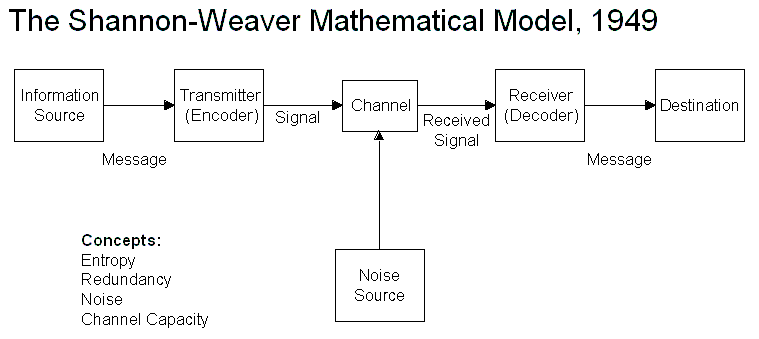
Shannon & Weaver were mathematicians at Bell Laboratories when they developed a new model. This model (linked above) magnified Lasswell's brainchild. Shannon & Weaver believed communication to be "information to reduce uncertainty." The new form incorporated an idea known as "noise," or the internal and external barriers challenging sound communication. The two believed in redundancy to reinforce points when faced with the noise. Also, Shannon & Lasswell were the first to acknowledge information as a key characteristic and the first to introduce communication to academics.

Wilbur Schramm's Model (1954)


model two


Schramm introduced three models of communication in succession, each of which elaborated on the former. His first method involved a source sending a message through an encoder, which would deliver it to a signal, a decoder would take the information and present it to the destination. Utterly confused yet? The information passed from the source is packaged and delivered and then dolled up into lay man's terms before reaching its destination. The second model incorporated overlapping fields of experience. The signal is where the two fields are familiar with one another. The third model was the first to introduce feedback into the equation. The overlapping fields were replaced with two separate entities that would relate back and forth to one another through the use of feedback.

Katz & Lazarsfeld Model (1955)


Katz & Lazarsfeld were political scientists who were the first to include mass communication in a model. At the time, radio and print were emerging as the most effective means of mass media advertising. The message would be delivered through mass media to an "opinion leader," who would present the message to the public. This created an interpersonal addition to the previous models.

Westley-MacLean Model


Westley and MacLean believed that the communication process starts with an advocate. That is, events occur and are taken by an advocate and presented through a channel to the audience. The audience in turn gives feedback to the advocate. Some events are so large in scope that they do not need an advocate.

This model is especially evident in my day to day job functions. My current position involves supporting and training users on a new computer system. When a new feature is added (the event) it is my task to advocate these changes through the appropriate channels in order to reach my audience in the most effective manner. I receive feedback on many levels. Some understand the training while some do not. Others appreciate the benefits of the new system and some resist it. But the inclusion of the interpersonal communication between the advocate and the audience in this model is what makes it so effective.

Kincaid's Convergence Model (1979)


Kincaid's model determined that communication is more than just a model of definite outcomes. His take is that communication is a process that is cyclical and evolving over time. There is no singular event with communication and as information changes, so does the means to communicate.

As I mentioned earlier, my original position with my company was in sales. I had a supervisor, colleauges and clients. Now that I am out of sales, my spot on the organizational hierarchy has changed. I am on the same level in the organization as my old supervisor. Our communication has changed. Where once we worked together to better our department, we now work together on a larger scale to better the company as a whole. As our professional relationship evolves, we will no doubt find new ways to communicate with one another as our experience with our respective temperaments and ideals matures.

In Conclusion

The various communication models discussed show how our methods have changed throughout the years. Not surprisingly, each new model digs a little deeper than its predecessor. The models, just like business, are constantly evolving. An excellent piece by Business Week discusses how blogs are changing the business world. This is a perfect example of the effect of mass communication.

I would be remiss to not mention the current financial crisis. In closing, here is a clip of Bill Clinton on NBC's Today acting as an advocate to present the crisis and its meaning to a mass audience.


Friday, September 19, 2008

Changing Environment of Business

To trust or not to trust?

Times are changing. Have changed. Will change. The influx of technology in the past twenty years has changed the scope of the world. International communication is a click away. Information flows like the Nile. The public is inundated with media. The slightest slip up by an organization can cause a public outcry rivaling a bad call by a referee during a Steelers' game.

Companies have evolved through the years, there is nothing to dispute that. Not evolving, however, is the public's opinion of these companies. From the "robber barons" of early industry to the present day white-collar to orange jumpsuit clad executives from Enron, WorldCom and the like, public perception of these corporate titans is filled with resentment and bitterness.

Our text, Corporate Communication, by Paul Argenti sites a decades-old survey that asks the question, "Does business balance profit and public interest?" In 1968, the majority of the population (70%) answered yes to the question (Argenti). By 1999, only 28% of respondents felt companies balanced profit and public interest (Argenti).

It is of utmost importance to these organizations that they keep a pulse on the effect their company has on the public and the community.

Breaking down the walls

A wise organization keeps an open line of communication to their constituents. In this case, the word "constituents" could mean employees, customers, shareholders, competitors, the government and/or any other person or institution that is affected by an organization.

As previously mentioned, technology has created a new brand of business that companies and their managers must recognize. In order to manage and incorporate this change in day to day operations, organizations should adhere to a basic framework of topics to ensure they are "Keeping up with the Jones'".

Recognize the Changing Environment

The text mentions McDonald's realization that their customers were put off by the use of non-recyclable materials in their packaging. At first, the fast food giant resisted change. But as time went on, their desire to avoid alienating customers came to the forefront and McDonald's changed. This decision helped ease the consumers and McDonald's was applauded for their efforts.

My company recently debuted a new computer program aimed to enhance our presence in the very profitable value-added sector of the steel industry. Incidentally, part of my job function is to train colleagues to use this program. The ultimate goal is to have our employees and customers work in partnership on this system.

There have been restraints. Many employees are old hat in the sense they see no need for such an initiative. They have sold steel for twenty plus years and have always been successful, so why change now? Part of my training process is to explain the pros - and cons - of our new system. At times it is hard to sell our people on the need for change. They feel as if I am trying to sell the sizzle and not the steak. My objective is to help them recognize the benefits of the change and help them implement our plans. After all, if the users are not fully on board, how can they effectively present this new program to our customers?

Adapt to the Environment without Compromising Principles

To remain successful for an extended length of time, an organization needs to embrace a set of ethical standards and principles. These principles need to be adjusted and cultivated over time to ensure a positive reputation is maintained.

A few years ago, China began producing steel that was much less expensive than steel produced domestically. While resistant to do business with the Chinese, my company relented and began buying offshore. The decision was made for competitive reasons. Our management did not like it, but to remain a player in the industry it was necessary.

Eventually, the fears of our management were realized: A large shipment of poor quality material had been purchased by us and sold to our customers. Above all things, quality for our customers is the number one requirement. Hundreds of thousands of dollars in credit were issued to our valued customers. We adapted as necessary but did not lose focus on what remains most important.

Don't Assume Problems Will Magically Disappear

In short, remain diligent and stay focused. This is especially relevant today. Many times each day emails circulate that have three, four or more people "cc'd". Sometimes these emails involve problems or situations that require action. I always make sure to follow up on the topic at hand, even if the question or issue was not directly pointed towards me. Resolution happens when all parties communicate and work together to achieve a goal.

Keep Corporate Communication Connected to Strategy

Each morning when I get to the office I have three objectives: 1) Get coffee. 2) Check e-mail. 3) Log in to the "Strategic Plan" database and review objectives and goals I set for myself days or weeks prior. Many days are spent completing said objectives. Each employee of the marketing department is expected to keep their strategic plan up to date. Even though many of us are scattered in different offices across the country, we are able to catch up on each others' projects within minutes - simply by accessing the site.

If one colleague in Denver sees a similar objective from Boston, he/she is able to communicate this. Had the database not been available, the left hand would have been working and the right hand may have stayed idle.

Moving Forward

The dynamics of business are changing every day. Actions never before seen are in the forefront as I type this entry. While a cliche, we never truly know what will happen. Let us hope that during this massive financial crisis, the top managers of our nation's financial institutions adhere to the communication principles we have discussed thus far. Digging from the bottom up will not be easy, but sound communication will alleviate some of the pain.